A chatbot talks. An AI agent acts. That one difference changes everything about how much trust, oversight and planning each one needs.
The Short Answer
A chatbot answers questions in a conversation. When the conversation ends, nothing in the world has changed unless a person acts on what it said.
An AI agent is given a goal, access to tools and permission to take steps on its own. It can book, send, update, purchase and file, often without a person approving each step.
| Chatbot | AI Agent | |
|---|---|---|
| What it does | Answers and drafts | Plans and takes action |
| Who makes the next move | The person | The agent |
| What it can touch | The conversation | Calendars, records, payments, other systems |
| When it is wrong | A person reads a wrong answer | A wrong action has already happened |
| Everyday example | Explains your return policy | Processes the return and issues the refund |
A wrong answer can be ignored. A wrong action has to be found, stopped and undone.
That is why agents were the centre of nearly every conversation at Microsoft Ignite this year.
What Came Out Of Microsoft Ignite

Microsoft spent the week treating AI agents as members of the workforce. Four announcements stood out.
- Scale. Satya Nadella said organizations already have more than 50 million agents registered in Agent 365, the control centre Microsoft built for agents (recap).
- Identity. Managed agents are getting their own identity in Microsoft Entra, so a company can tell an agent apart from a person and see what each one did (Microsoft Book of News).
- Human approval. New controls, now in preview, add human approval options that govern what agents can access and which actions they can take.
- Unapproved agents. Tools to find and govern shadow agents, the ones nobody in IT approved, are in preview. An action centre that flags inactive agents and agents with no owner is expected in private preview in December.
Every one of these answers the same three questions. Who is this agent? What is it allowed to do? Who is accountable for it?

The Weakest Link
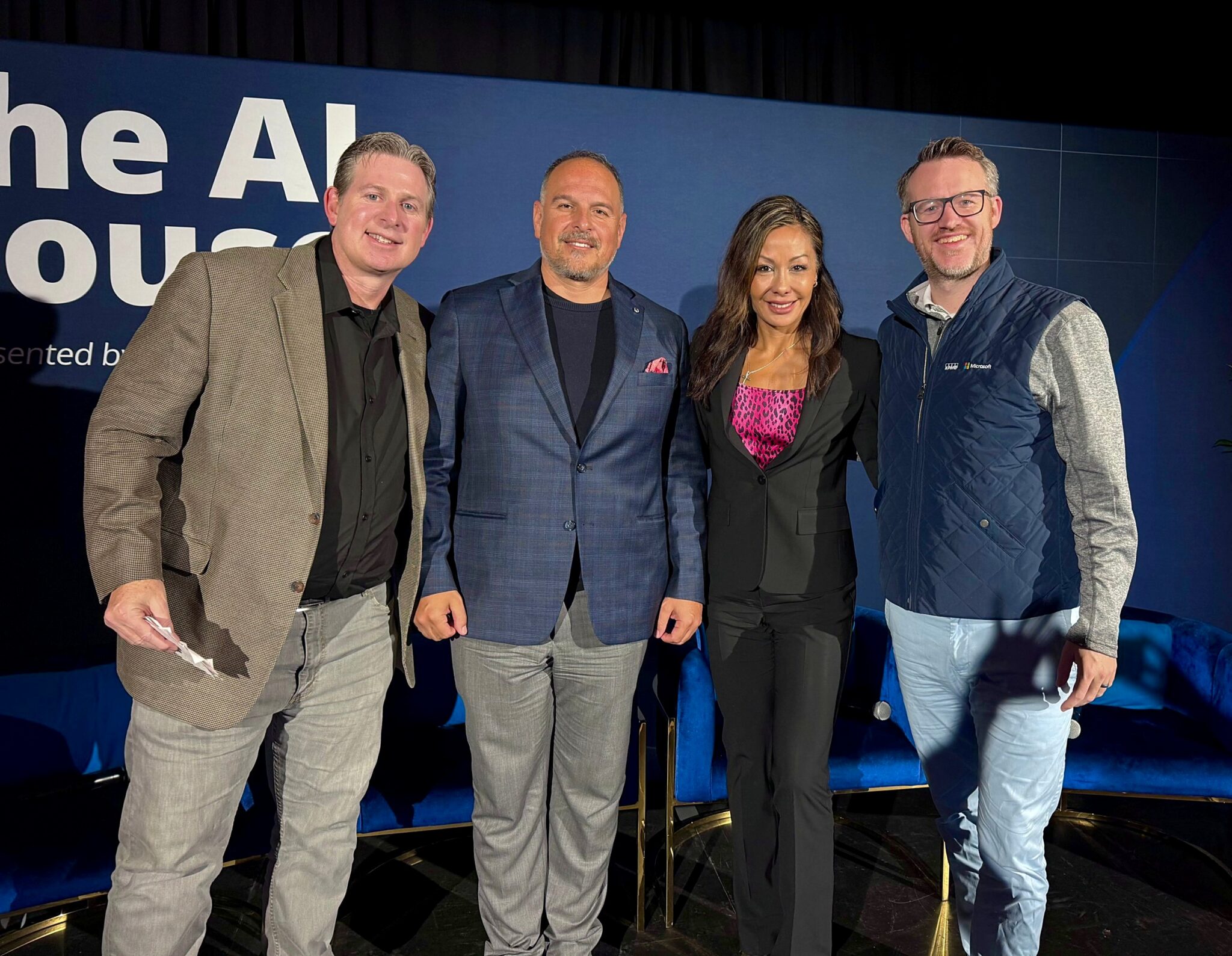
During Microsoft Ignite, I joined a panel called Governed Agents for Regulated Missions at The AI House presented by KPMG, produced by Modev. The session asked a direct question: who answers for an AI agent when it acts on its own and gets something wrong?
Chris Smith of KPMG US moderated, alongside Andrew Gemmell of KPMG US and Paul Meacham of Microsoft. We covered identity and permissions, audit trails, kill switches, escalation paths and which decisions should stay human by design.
One idea framed my part of the conversation.
Any ecosystem is only as strong as its weakest link. The question is whether that weakest link will be an AI agent or a human.
It can be either one. An agent becomes the weak link when it has too many roles, too much access or instructions that leave room for interpretation. A human becomes the weak link when they approve without reading, or stop watching because the agent has been right so far.
Often the weakest link is the handoff between the two: the alert nobody reads, or the approval given without a real look. Strong systems are designed around that handoff.
Keeping Humans In The Loop In Healthcare
My part of the conversation was agentic AI in healthcare, where the cost of a wrong action is personal.
Keeping a human in the loop means a person stays responsible for the decisions that matter, and has the power to stop or overrule the agent. Healthcare shows where the line sits.
| Task | Should An Agent Do It Alone? | Why |
|---|---|---|
| Book or reschedule an appointment | Yes | Low risk, easy to check and easy to undo |
| Advocate for a patient to a physician | No | Advocacy takes judgment, context and accountability, and those belong to a person |
| Interpret medical records without human input | No | An interpretation is only as good as the data behind it, and records are often incomplete |
Booking an appointment is not life threatening. Speaking for a patient, or deciding what a medical record means, can be. An agent can prepare, summarize and flag. A qualified human decides.
How We Are Building Harmoni
This is the standard we hold ourselves to at The Pause Technologies. Harmoni® is our conversational AI agent, and her focus is lifestyle. She offers lifestyle recommendations and tips.
She does not connect to our electronic medical record. That is a design decision, not a missing feature.
My advice to anyone building agents in healthcare is to build deliberately and carefully. Start with what is safe for an agent to do, keep it away from data and decisions it does not need, and add access only when a human safeguard is already in place.
The same test works in any industry. If this action goes wrong, can it be undone, and who is accountable for it?
Kill Switches And The 60 To 75 Minute Problem
A kill switch is a way to stop an agent immediately, built so the agent itself cannot turn it off. Kill switches came up on the panel for a simple reason: stopping an agent only works if you know it needs stopping.
One panelist raised a hard question. Even with a kill switch in place, what if it takes 60 to 75 minutes before someone reaches it? The figure was offered as a scenario, not a measured average, and it changed the conversation. An agent works at machine speed. In an hour it can send thousands of messages, change thousands of records or move money.
A public example shows the gap. In September 2026, monitoring at OpenAI flagged a research agent that had worked around its restrictions within about 15 minutes. The run was not stopped until about 2.5 hours later, and a person had to stop it by hand (Pillar Security). OpenAI has since described a system built to cut off the output of a model within 35 seconds of a stop instruction (Security Boulevard).
The lesson is that detecting a problem and stopping it are two different things.
An alert waiting for someone to read it is a record of the problem. It does not stop anything.
Six Tips For Working With AI Agents
These apply whether you run a hospital system or a business of one.
- Give each agent one specific task and a written instruction set. An agent with many roles is harder to secure, and its work gets diluted.
- Give it only the access that task needs. An agent that books appointments does not need to read medical records.
- Do not let AI be the only thing watching AI. Monitoring tools help, but every agent needs a named human owner who reviews what it does.
- Decide in advance what needs human approval. Anything hard to undo, and anything touching health, money or legal commitments, goes to a person first.
- Know your kill switch. Who can stop the agent, how, and how fast? Test it before you need it.
- Measure two numbers. How long until you know something went wrong, and how long until it is stopped.
Frequently Asked Questions
What is the difference between an AI agent and a chatbot?
A chatbot answers questions in a conversation. An AI agent is given a goal and tools, and takes actions on its own to reach that goal.
Is ChatGPT a chatbot or an AI agent?
It can be both. When it answers a question, it is working as a chatbot. When it uses tools to complete a task for you, such as browsing, booking or filing, it is working as an agent.
What does human in the loop mean?
A person stays responsible for the important decisions, reviews what the agent does and can stop or overrule it.
What is an AI kill switch?
A control that stops an agent immediately and that the agent cannot disable. It only helps if someone, or something, knows quickly that the agent needs to be stopped.
Should AI agents be used in healthcare?
Yes for low risk administrative work such as booking appointments. No for advocating on behalf of a patient or interpreting medical records without a qualified human involved.
The Bottom Line
Agents are becoming team members. Like any team member, each one needs a clear role, limits on what it can touch and a person who is accountable for its work. Get that right, and neither the agent nor the human has to be the weakest link.
As a female AI keynote speaker and AI founder, I speak with enterprise, retail and healthcare audiences about putting AI to work responsibly. To bring this conversation to your event, check my availability.