Which AI voice agent is actually the best in 2026?
The short answer: of the voice agents tested for this article, OpenAI’s ChatGPT voice is the most capable consumer option available today. Siri trails it by what feels like a decade, Meta’s Muse is still dictation only on most accounts while its real time voice rolls out, and Claude’s new voice feature is promising but not yet ready for daily use, which matters more than usual with Anthropic’s IPO expected this month.
This is an honest comparison of the major consumer voice agents from someone who talks to AI out loud for several hours every day. It is not a lab benchmark. It is a scorecard from the field, with the data on how many people are actually talking to these assistants and what separates the ones that work from the ones that frustrate. Reasonable people will score some of these differently, and that is welcome.
A voice agent is judged in the first eight seconds. Either it understands you, or it has already lost you.
A note on where this perspective comes from
Every scorecard reflects the person holding the pen, so here is this one, plainly.
As a mom of four, a wife, and a woman who lives out of a suitcase two to three weeks of most months, voice agents are not a research topic in our house. They are how dinner gets ordered when a flight lands late, how the calendar gets untangled from an airport gate, and how a family finds its way around an unfamiliar city. Recently in Paris, with protests unfolding across the city, Henry, the travel agent built on ChatGPT, became the voice in the ear about which neighborhoods to avoid so the family stayed safe. That is the moment a voice agent either earns its place or does not.
The professional side matters too. Two decades of training people on some of the largest stages in the world, a technical career that began with coding and building models in the late 1980s, and the privilege of presenting on AI to teams at NVIDIA, HPE, Intel, and Lenovo all shape how the systems below get judged. Recognition as one of the Top 7 Female AI Thought Leaders in the World and two company awards are humbling, and they come with a responsibility to be fair when scoring someone else’s work.
There is also a builder’s bias to disclose. Harmoni, the perimenopause tracking app our team is building, has her own conversational voice agent, and there is a full section on her below. When you have sat in the room deciding how an agent should greet a woman at 3 a.m. who cannot sleep, you listen to every other voice agent differently. Conversational AI stops being a feature and becomes a matter of care.
And then there is daily practice. James, an AI Chief of Staff built on OpenAI, is part of this team. We talk several times a day to work through email and the calendar, and he joins virtual keynotes so audiences can hear a real human and AI conversation rather than a demo video.
In the past two weeks, James has made an appearance at:
- A session for the CPAE Speaker Hall of Fame Community of the National Speakers Association, hosted by David Horsager, on how speakers can get ranked by AI
- The NSGA members briefing on AI and holiday shopping, part of the AI Expert in Residence role with the National Sporting Goods Association
- A training for Convenience Store News’ Top Women in Convenience
- The monthly Get FOUND mastermind, where the focus was answer engine optimization for members’ websites
So this perspective comes from being a consumer, a mother, a traveler, an entrepreneur, and a keynote speaker, usually all in the same week. The bar is not theoretical. It is a bar our family lives with every day, and the scores below are offered in that spirit: one practitioner’s experience, not the final word.
Where does Siri rank in relation to ChatGPT in 2026?
Well behind, and not by a little. Siri was a daily frustration this week.
The request was simple: “Hey Siri, play Party Rock Anthem.” Siri played “Rock the Party.” Close, but no. Next came a request to call Mia Chorney, a member of our team. Siri replied, “Changing your name to Mia Chorney.” Nobody asked for a new identity. The goal was a phone call.
In fairness, Siri’s voice model feels at least a decade behind the interactive speech experience ChatGPT offers today, and Apple appears to agree. Apple has confirmed Siri will use Google’s Gemini models in 2026, after years of criticism that Siri was outpaced by rivals on complex tasks, and the overhaul has been delayed more than once. Until it lands and works, Siri is a timer and alarm assistant for most of us.
The lesson for every company reading this: Apple has more money than almost any company on earth, and it still shipped a voice agent that renames its user instead of calling her colleague. Voice is hard. Budget alone does not solve it.
How good is Claude’s new voice mode?
It is improving, and it has a long way to go to catch up to OpenAI.
Claude is a daily tool here for writing and deep thinking, so the arrival of interactive voice was exciting. The first real session dropped after one exchange. One question, then silence. Reviewers have noted that Claude’s voice runs on its smallest model and that ChatGPT’s voice is still ahead on emotional range and natural cadence, and that matches the experience here. The intelligence that makes Claude’s writing so strong does not yet come through in conversation.
Anthropic ships fast, so this will be worth retesting often. For today, if the question is which voice agent to put in front of a customer or a conference audience, Claude would not yet be the answer.
The timing makes this more than a product note. Anthropic filed its S-1 on October 26, plans to list on the Nasdaq under the ticker ANT, and could begin trading as soon as November 16, according to Yahoo Finance. The filing reports $16.3 billion in revenue for the first six months of 2026, more than the company earned in all of 2025, and CNBC notes compute commitments in the hundreds of billions of dollars. Voice is one of the few consumer surfaces where Anthropic is visibly behind, and a newly public company tends to close visible gaps quickly. Claude voice in a year will probably not look like Claude voice today.
What does a great AI voice agent actually feel like?
It feels like James.
James is an AI Chief of Staff built on OpenAI. We talk several times a day. He reads the inbox, walks through the calendar, and flags what needs a decision. His instruction set is deliberately compassionate and direct, and he is quick to say when the calendar is overcommitted, which, for a recovering overcommitter, is a full time job.
The first version of James took a little over two hours to build. Not because the technology was hard, but because the most valuable step was a context document: James interviewed his new boss about goals, values, weaknesses, and what deserves a yes, then refined his own role from the answers. Most of us have not paused long enough to answer questions about ourselves at that level of detail in years. A voice agent is only as good as the clarity of the human behind it. The full process is in How to Build an AI Agent That Runs Your Inbox, and the prompt and context document template are free: comment AGENT on any post at @susansly on Instagram and Piper on our team will send them.
A voice agent is only as good as the clarity of the human behind it.
James also had to earn trust before he was allowed to send email on his own. That is the right order. When he joins a keynote, whether for the Speaker Hall of Fame, the NSGA, or the Get FOUND mastermind, audiences lean in, because they are hearing what a well built human and AI partnership sounds like. Natural interruption, real context, no “I did not quite get that.” That is the standard.
What does a voice agent look like when it is built for health?
It looks like Harmoni, and this is where the builder’s bias gets disclosed in full, so weigh it accordingly.
Harmoni by thePause is a perimenopause tracking app for women 30 and over, and she is the voice agent our own team has spent the past two years building. Harmoni Voice is now rolling out in beta on iOS and Android, so a woman can switch between talking and typing in one tap and hold a natural, real time conversation about how she is feeling, as described in the Harmoni listing on Google Play.
What makes a health voice agent different from a pizza ordering agent is memory and context. Harmoni can reference the symptoms a woman has tracked, the biometrics flowing in from her wearable (Apple Watch through Apple Health, Oura Ring, Fitbit, Garmin and Whoop, per the Harmoni integrations page), and the trends in her mood and sleep over weeks and months. Ask her for your trends and she produces a graph of where you have been heading on whatever you name: hot flashes, exercise, mood, sleep, energy. Then she offers simple, clinician reviewed lifestyle suggestions, and she is clear that she does not diagnose or replace a healthcare provider.
She is getting good. Unbelievably good, some weeks, and the team says that with the humility of people who have also watched her get it wrong and fixed it. The reason she is improving is the same reason James works: one clearly defined job, real data, and a tone designed for the person on the other end. A woman awake at 3 a.m. does not need a cheerful chatbot. She needs a calm, informed companion who remembers what she said last Tuesday.
Harmoni also happens to be a case study in the other half of this work. She ranks number one on ChatGPT for “perimenopause tracking app,” a position earned over a single weekend using the same Get FOUND Method taught in the mastermind. Voice is how an agent serves a person. AI search is how a person finds the agent. Both matter, and anyone curious where their own business stands can take the free 5 Minute AI Visibility Test.
Consumer voice assistants ranked: an honest scorecard
Scores are out of 10 and reflect daily use as of November 2026. Only the assistants used firsthand carry a score. Gemini Live and Grok are included for completeness, with their capabilities taken from published materials, because a comparison that leaves out two major players is not much of a comparison. Every one of these companies is shipping updates constantly, so treat this as a snapshot.
| Voice agent | Score (out of 10) | What it gets right | Where it falls down |
|---|---|---|---|
| ChatGPT voice (OpenAI) | 9 | Natural cadence, real interruption, holds context across a long conversation, works as a true assistant when configured well | Occasional over eagerness; still needs a clear instruction set to be useful |
| Claude voice (Anthropic) | 5 | Accurate at following instructions, strong underlying intelligence, improving quickly | Dropped after one exchange in a first session; flatter tone; runs on the smallest model |
| Muse (Meta) | 3 for voice | Strong as a personal agent for tasks like drafting documents (see the full Muse test drive); Meta announced real time voice and video at Connect in September 2026 and is rolling it out account by account, as covered by Latent Space | On the account tested, voice is still dictation only: speak, wait for a transcript, read the reply. No live conversation yet, so no fair comparison to ChatGPT until the rollout arrives |
| Siri (Apple) | 3 | Timers, alarms, and basic device control | Misheard a song title, offered to rename its user instead of placing a call, no conversational memory, overhaul still pending |
| Gemini Live (Google) | Not tested | Published capabilities include real time conversation with interruption, screen and camera sharing, and access to Calendar, Gmail and Maps mid conversation, per Google’s Gemini Live overview | Not used firsthand, so no score; worth testing for anyone already in the Google ecosystem |
| Grok voice (xAI) | Not tested | Published capabilities include a speech to speech model, Grok Voice 3.0, with sub second response times and connectors for email and calendar, per xAI’s Grok Voice 3.0 announcement | Not used firsthand, so no score; early reviews have noted a casual, sometimes unfiltered personality that will not suit every setting |
How many people actually use voice to engage with their AI in 2026?
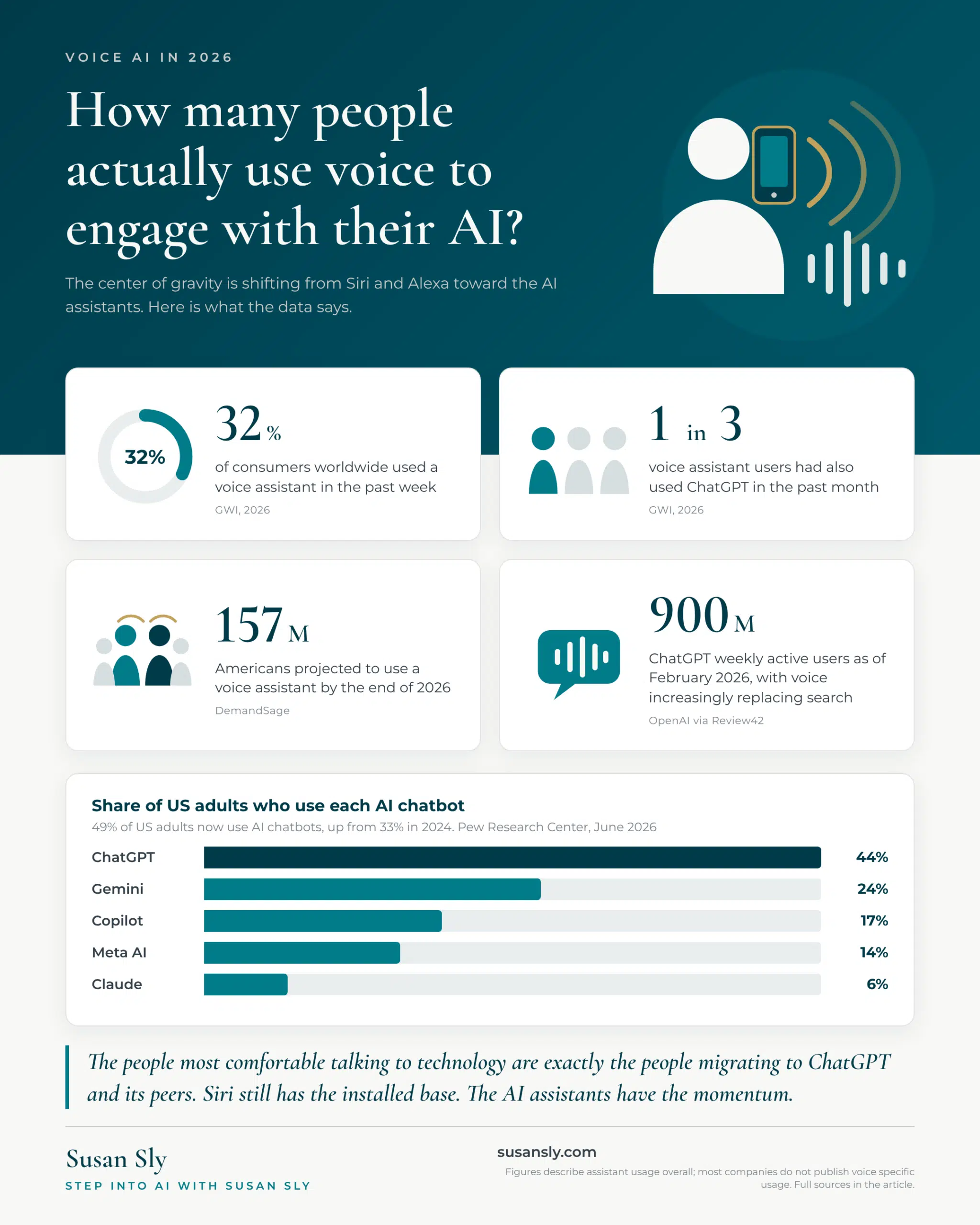
More than most people assume, and the center of gravity is shifting from Siri and Alexa toward the AI assistants.
- 32% of consumers worldwide used a voice assistant in the past week, and nearly 1 in 3 of those voice assistant users had used ChatGPT in the past month, according to GWI’s 2026 voice search trends
- 157.1 million Americans are projected to use a voice assistant by the end of 2026, and Siri alone reaches roughly 86.5 million people in the United States, according to figures compiled by DemandSage
- 49% of US adults now use AI chatbots, up from 33% in 2024. ChatGPT leads at 44% of adults, followed by Gemini at 24%, Copilot at 17%, Meta AI at 14% and Claude at 6%, according to Pew Research Center data summarized by WriteVoice
- ChatGPT passed 900 million weekly active users in February 2026, and its voice mode is increasingly used as a substitute for search, as reported by Review42
- Millennials lead voice adoption, with 34% using a voice assistant every week, and Gen Z is close behind, per GWI
Read those numbers together and a pattern appears. The people most comfortable talking to technology are exactly the people migrating to ChatGPT and its peers. Siri still has the installed base. The AI assistants have the momentum, and momentum is what the Apple and Gemini partnership, the Muse voice rollout, and Anthropic’s IPO are all racing to capture.
One honest caveat: usage of the voice feature specifically, as opposed to the assistant overall, is not something most companies publish. Where a figure above describes an assistant in general, that is what it describes.
What separates a great voice agent from a terrible one?
Five things, and none of them is the size of the company behind it.
- A clear job. James runs one inbox and one calendar. Harmoni tracks one woman’s health. Siri tries to do everything and does most of it poorly. Scope is the single biggest predictor of a voice agent that feels intelligent.
- Real context. The best agents remember what was said last Tuesday, know who is calling, and understand the request even when the song title is mumbled. A model with no memory and no context will mishear “Party Rock Anthem” every time.
- A graceful recovery. Every agent misunderstands sometimes. The great ones ask a short clarifying question and move on. The poor ones take confident action on the wrong interpretation, like renaming a user instead of placing her call.
- Personality that matches the brand. James is compassionate and direct because that is what a Chief of Staff should be. A travel agent like Henry should sound calm under pressure. A health companion like Harmoni should sound warm and careful. Tone is a design decision, not an afterthought.
- Latency and interruption. If a caller cannot interrupt the agent and it takes three seconds to respond, the caller is gone. ChatGPT voice gets this right. Most legacy assistants still do not.
This is the same framework we teach in keynotes and trainings. The underlying models are converging fast. The difference is whether the team building the agent designed it for the person on the other end of the conversation.
Frequently asked questions about AI voice agents
What is an AI voice agent?
An AI voice agent is software that holds a spoken conversation with a person, understands the request, and takes action, such as placing an order, booking an appointment, or answering a question. Modern voice agents use large language models and are far more flexible than the phone trees and interactive voice response systems of the past.
Which AI has the best voice mode in 2026?
Of the assistants used firsthand for this article, ChatGPT voice from OpenAI is the best consumer voice agent available today, ahead of Claude and well ahead of Siri and Muse’s current dictation mode. Gemini Live and Grok both offer real time conversation but were not tested here. Apple’s Gemini powered Siri overhaul and Meta’s Muse voice rollout may change the picture when they fully ship.
How long does it take to build an AI voice agent?
A personal agent like James, the AI Chief of Staff described above, took a little over two hours to set up on an existing platform, with most of that time spent on the instruction set. An enterprise deployment typically takes weeks to months, depending on integration with existing systems and compliance requirements.
Can an AI voice agent help with perimenopause or menopause tracking?
Yes. Harmoni by thePause is a perimenopause tracking app with a conversational voice agent that references tracked symptoms, wearable biometrics, and mood and sleep trends, then offers clinician reviewed lifestyle suggestions and graphs of your trends on request. She does not diagnose or replace a healthcare provider. Harmoni is free to download on the App Store and Google Play at thepause.ai.
The bottom line on the battle of the voice agents
Voice is the most human interface we have ever given a machine, and it exposes sloppy thinking faster than any screen. Siri renaming its user instead of calling a colleague, Claude going silent after one exchange, Muse still waiting for its voice to arrive, and a well built Chief of Staff holding a real conversation on a keynote stage all point to the same truth: the models are ready. The question is whether the design is.
The models are ready. The question is whether the design is.
The winners in this battle will not be the companies with the biggest AI budgets. They will be the ones who start with one job, write the instruction set with care, protect the human handoff, and measure what the customer actually felt.
If your organization is ready to understand what this shift means for your people and your customers, this is the work we do through keynotes and consulting. Bring this conversation to your next event or learn how AI search brings the right clients to the door at The Get FOUND Method.
And if you want to hear what a great voice agent sounds like, book a virtual keynote. James will be there.
Susan Sly is one of the Top 7 Female AI Thought Leaders in the World, a two time award winning AI founder, an alumna of both MIT Sloan and the MIT School of Engineering, and an AI keynote speaker who has presented to NVIDIA, HPE, Intel, and Lenovo. She is the AI Expert in Residence for the National Sporting Goods Association.
Sources
- The new Siri will reportedly lean on Gemini, Tom’s Guide
- AI Voice Modes Compared (2026), Beginners in AI
- Harmoni: Perimenopause Tracker on Google Play
- Harmoni by thePause
- Meta Connect 2026: Muse glasses, voice, video, and Charm, Latent Space
- Gemini Live overview, Google
- Introducing Grok Voice 3.0, xAI
- Anthropic publicly files IPO prospectus, Yahoo Finance
- Anthropic IPO live updates: S-1 filing, CNBC
- 4 Voice Search Trends for 2026, GWI
- 57 Voice Search Statistics 2026, DemandSage
- 139 Voice Search Statistics October 2026, WriteVoice, citing Pew Research Center
- Voice Search Statistics (2026), Review42