From answering to acting
This week I closed the day on The AI House Stage at AGENTIC AI North America, just outside Washington, DC, in a fireside chat on agentic safety in healthcare and local government with Noelle Russell, Founder and Chief AI Officer of the AI Leadership Institute.
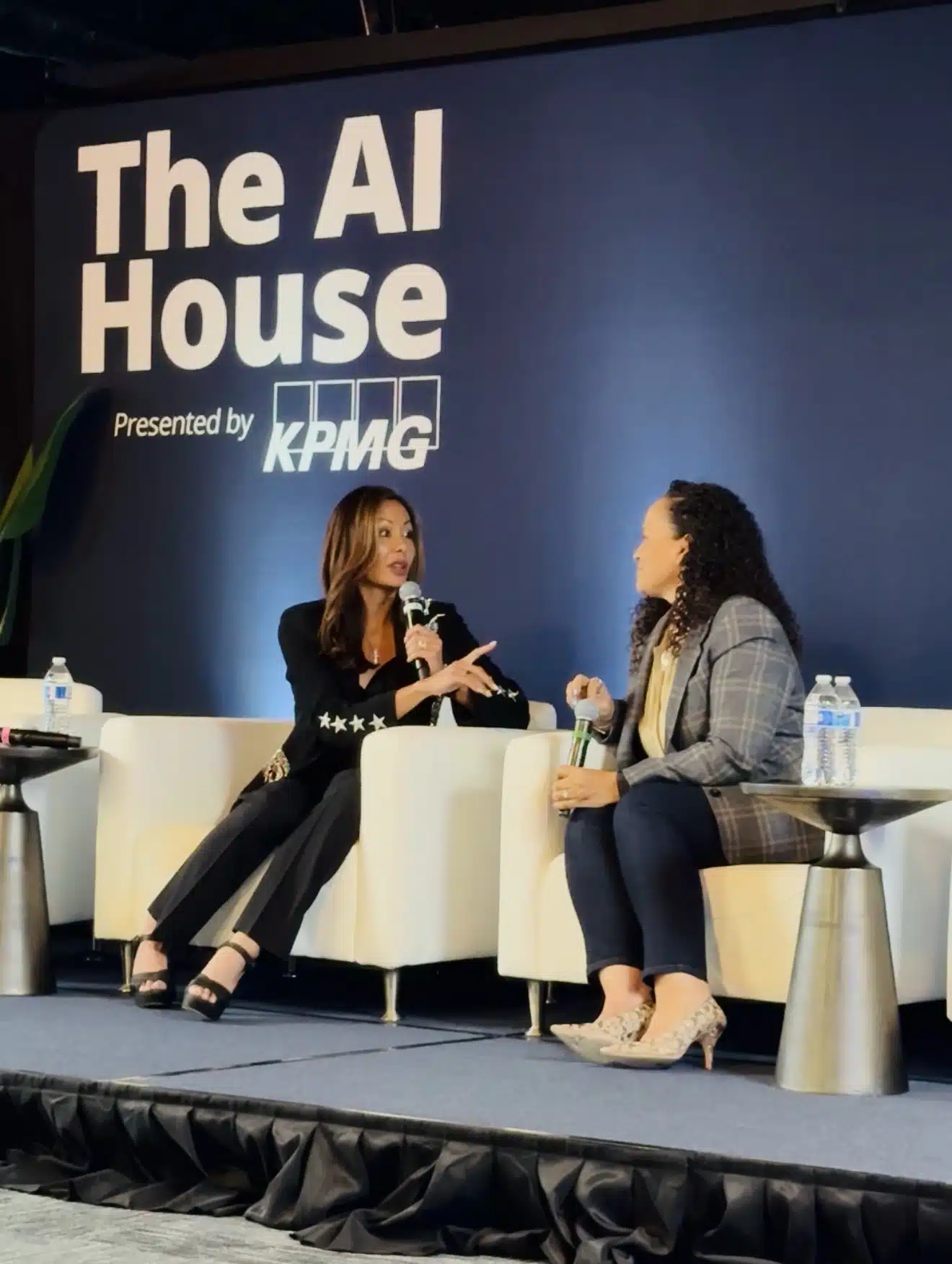
With Noelle Russell on The AI House Stage at AGENTIC AI North America.
The room was full of enterprise leaders, engineers, founders, and investors, the people who decide how agents get deployed. Noelle and I have more in common than a stage. We are both mothers of four, and we both carry the skinned knees and bruises of deploying AI in the real world. That is why the conversation stayed practical.
I opened with the question that framed our 25 minutes. AI is moving from answering questions to taking action. What does that mean for safety, trust, and the people we serve?
An assistant that gives you a wrong answer costs you a few minutes. An agent that takes a wrong action can move money, change a record, or send a message in your name.
The technology is similar. The stakes are not.
The numbers tell a calmer story than the headlines. In McKinsey’s State of AI survey, 62% of organizations said they were at least experimenting with AI agents, while 23% said they were scaling them, usually in only one or two functions. Gartner predicts that more than 40% of agentic AI projects will be cancelled by the end of 2027, because of rising costs, unclear business value, or inadequate risk controls.
Most organizations are still learning. That matches what Noelle and I see in the field.
Where companies are creating risk
I asked Noelle where companies are creating vulnerabilities as they pursue productivity and profitability. She named four.
| Vulnerability | What it looks like |
|---|---|
| Excess authority | The agent is allowed to do far more than its job requires |
| Sensitive data | The agent can read information it never needed to see |
| Connected systems | One agent touches many tools, so one mistake travels |
| Unclear ownership | Nobody can say who is accountable for what the agent does |
Noelle emphasized all four, and she speaks from experience. She has led AI work inside some of the largest technology companies in the world, and she is the author of Scaling Responsible AI: From Enthusiasm to Execution. Her next book, Scaling Agentic Systems: A Leader’s Field Guide for Deploying Safe Agents at Scale, comes out from Wiley in March. If you lead a team that is deploying agents, put it on your list.
What can an agent do alone?
The follow up question is the one every leader should ask. What can act independently, and what requires human approval?
I use a simple rule with my own agents. When I built my first inbox agent, its first instruction was “Never send an email. Drafts only.” My AI Chief of Staff sends email under his own name today, and he earned that over time. Trust is earned, even by software.
If you want to see that rule in practice, I shared the full prompt in How to Build an AI Agent That Runs Your Inbox in Less Than 10 Minutes.
Healthcare makes the stakes tangible
Noelle turned the questions to me, starting with an invitation I received in May. I thought it was spam. It was the American Medical Association, asking me to join a closed door session of 49 people on the future of the physician and AI, alongside senior healthcare leaders from the major AI and technology companies. I spoke about Kremer’s O-Ring Theory, and about using AI to create speed to intimacy between humans. By that I mean two things: speed to quality care for the patient, and the joy of practising medicine for the provider.
How will physical and agentic AI shift healthcare, and what must people adapt to?
I shared what my team is building and deploying: AI agents that improve the speed to quality care for women and men in midlife. The system today is incredibly frustrating. When people want care, they are forced into legacy workflows, including endless paperwork that asks for the same information again and again. At the same time, there is a shortage of qualified providers, especially those certified in menopause and perimenopause care.
We are weighing down the system with antiquated practices that benefit no one.
So what should patients experience differently? Speed. They should get to the right provider faster.
The vision is an AI agent that processes data the patient has approved and connects that person to a provider sooner. The agent also populates the electronic medical record, so a provider who is usually overbooked can see a holistic view of the patient at a glance. The visit becomes more effective for both of them.
That is what I want agents to give us: more room for care, easier access to services, and always a path to a person.
Take the fear seriously
I asked Noelle how she addresses worst case scenarios and client concerns. She went straight to ownership. In many organizations, nobody owns the agent. So when something goes wrong, there is no specific person to go to.
Noelle also offered a view you will not hear from the doomscrollers. Adoption is not moving as fast as the headlines suggest. Enterprise adopts AI slowly, which means leaders still have time to get this right.
If you take one thing from this piece, take that. Before an agent acts, name the person who owns it.
I also shared what I learned deploying AI at scale, and the power of bringing different perspectives into the room. At my computer vision company, we brought in cashiers, store managers, and people from store security, marketing, human resources, legal, and operations. Why? Because bringing the humans together, each with a different lens, created a fuller picture than any one team could have seen alone.
What excites us about the agentic future
When I asked Noelle about the agentic future, she offered a caution that I respect. These agents may sound friendly, but they are not your friends.
My perspective is a little different. James and Pembrooke, my AI teammates, let me take what is in my brain, which is unstructured data, and give it structure. That is what excites me most about the agentic future.
People from all backgrounds will be able to take their ideas and execute them.
We ended with our favourite tools
We closed on a lighter note, with one question for each other: which tool are you burning the most tokens on? For me, it is Claude. For Noelle, it is Lovable.
Your turn: choose one workflow
Here is the one thing I would ask you to do after reading this.
Choose one workflow. Then answer two questions.
- What could an agent contribute to it?
- What human responsibility must remain clear?
As a female AI keynote speaker, I help leaders adopt AI in a way that keeps people at the centre. If that is the conversation your event needs, check my availability.
Frequently asked questions
What is the difference between an AI assistant and an AI agent?
An assistant answers when you ask. An agent takes action inside your tools, often without being asked each time.
What is agentic AI safety?
It is the practice of deciding, before an agent acts, what it is allowed to do, what it can see, and which named person is accountable for it.
What are the biggest risks of AI agents?
Four came up in our conversation: giving an agent more authority than its job requires, exposing sensitive data, connecting it to many systems at once, and leaving ownership unclear.
Should AI agents act without human approval?
Some actions, yes, once trust is earned. Start with drafts and recommendations, and require a human yes for anything that spends money, changes a record, or speaks in your name.
How should a business start with AI agents?
Choose one workflow. Decide what the agent contributes and which human responsibility must stay clear. Then expand.