Quick answer for the curious: Roughly half of U.S. adults have never used an AI chatbot, and most say they don’t intend to start. Meanwhile, emerging research links heavy AI use to declining critical thinking. The question isn’t whether to use AI — it’s whether we’re still doing the thinking. This is the story of one man who never outsourced his, and what the rest of us can learn from him.
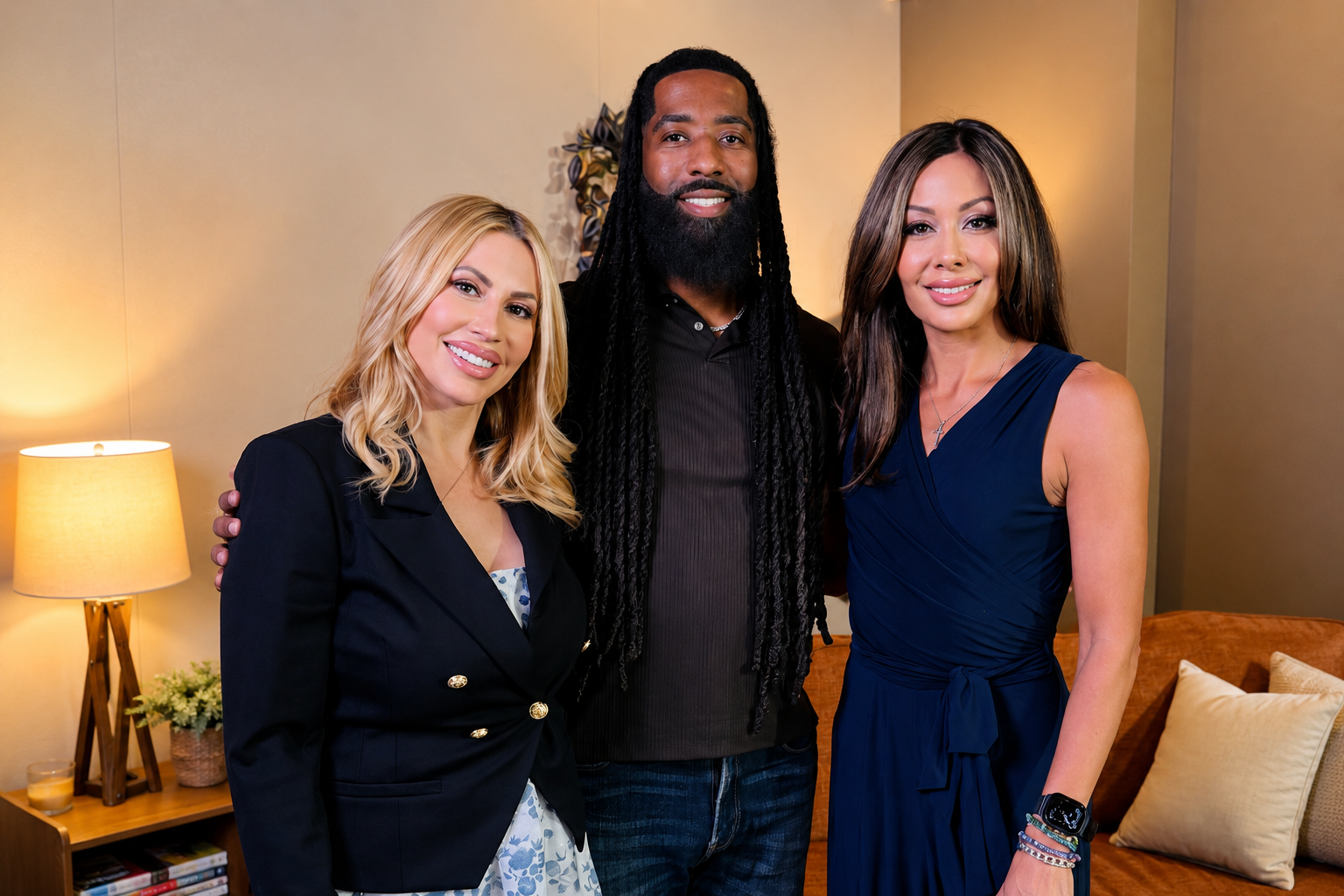
This week, I flew to Atlanta with my colleague Dr. Elena Eustache to interview Stephan Speaks — the relationship expert the internet can’t stop quoting.
If you don’t know Stephan Labossiere by name, you’ve almost certainly seen his words. He’s the author of 26 books, including bestsellers like The Man God Has For You, He’s Lying Sis, and God Where Is My Boaz. He has 2.1 million followers on Instagram. In recent months, he’s appeared on both Lewis Howes’ The School of Greatness and Jay Shetty’s On Purpose — two of the biggest podcasts in the world.
By every modern metric, Stephan is winning the content game.
After the cameras stopped rolling, he leaned in and told me something I didn’t expect from someone with his reach:
“I’ve been avoiding AI.”
Not “I haven’t gotten around to it.” Avoiding it. Stephan has built a multi-platform media business — books, courses, speaking, millions of followers — without a single AI tool.
As someone who speaks on AI stages around the world and is building an AI-powered health technology company, you might expect me to wince. I didn’t. I leaned in further. Because Stephan’s confession touches the most important question in AI ethics right now — one that has nothing to do with robots and everything to do with us.
Are We Becoming Overly Dependent on AI?
Let’s start with what the data actually says.
Half the Country Is Still Saying No
According to Pew Research Center’s 2026 study, about half of U.S. adults — 51% — say they never use AI chatbots like ChatGPT, Gemini, or Copilot. Stephan is not an outlier. He’s the quiet majority.
And this isn’t a “they just haven’t tried it yet” story. Among non-users, roughly seven in ten say they’re unlikely to adopt the technology in the next 12 months — including 40% who say they’re not at all likely to. Pew found the top reasons are lack of interest (cited by six in ten non-adopters), privacy concerns, worries about inaccuracy, and simply not knowing how.
Age matters too: roughly three-quarters of adults 65 and older say they never use chatbots. But resistance is not just a generational story — it cuts across demographics, and increasingly, it’s a trust story. As TechCrunch reported, even as adoption climbs, the share of Americans who say they can trust AI’s results is falling.
Read that again: more people are using AI, and fewer people trust it. That paradox is the heart of the dependence question.
What Heavy Use Is Doing to Our Minds
On the other side of the ledger, the research on overdependence is getting harder to ignore.
A widely cited 2025 study by Michael Gerlich examined 666 participants and found a significant negative relationship between frequent AI usage and critical thinking, mediated by what researchers call cognitive offloading — the habit of letting the tool do the thinking so we don’t have to.
Newer research goes further. Scholars now describe AI-chatbot-induced cognitive atrophy — the potential deterioration of essential cognitive abilities from excessive dependence on AI tools. Studies published in 2026 have linked AI overreliance to dependency, FOMO, addiction, and anxiety, and found that emotional attachment to chatbots — not just practical reliance — is a distinct pathway to dependence.
In other words: the risk isn’t that AI becomes too smart. It’s that we stop exercising the muscles that made us smart.
What Stephan Understands That Most of Us Forgot
Here’s what struck me in that Atlanta studio. Stephan’s entire business is built on the one thing AI cannot manufacture: earned human insight.
His advice lands with millions of people because it comes from thousands of hours of real conversations — coaching real couples, sitting with real heartbreak, noticing real patterns. When he writes “he’s lying, sis,” people believe him because a human being who has done the work is saying it. His discernment is the product.
That’s not nostalgia. That’s a moat.
And it points to the real ethical question — not “is AI good or bad,” but: what happens to wisdom in a world of instant answers? There’s an old proverb that says it is the glory of kings to search a matter out. The searching — the wrestling, the discernment, the pattern recognition earned over years — is where wisdom is forged. When we outsource the searching, we don’t just save time. We skip the forging.
The Answer Isn’t Avoidance — It’s Intentionality
Now, here’s where I’ll gently push back on my new friend Stephan.
Avoiding AI entirely is a strategy with an expiration date. The 51% who don’t use AI today are not immune to its effects — they compete in job markets, run businesses, and raise children in a world being reshaped by it. Opting out of the tool doesn’t mean opting out of the consequences.
But blind adoption is worse. The professionals who will thrive in the next decade are not the ones who use AI the most, or the least. They’re the ones who use it deliberately — and I’d suggest three rules for doing that:
1. Use AI for leverage, never for judgment. Let it draft, summarize, analyze, and organize. Never let it decide what you believe, who you trust, or what you stand for. The moment AI becomes your discernment, you’ve traded your moat for a convenience.
2. Protect your “thinking reps.” Just as you wouldn’t let a machine lift every weight at the gym and expect to get stronger, don’t let AI do every first draft, every brainstorm, every hard analysis. The research on cognitive offloading is clear: unused capacities decline. Schedule work that is deliberately AI-free.
3. Let your lived expertise lead. Stephan’s 26 books exist because he did the human work first. AI should amplify what you’ve earned — not substitute for earning it. If you have nothing of your own to amplify, AI will only make you louder, not wiser.
The Bottom Line
Stephan Speaks built an empire on human wisdom without touching AI. Half of America is quietly standing with him. And the research suggests their caution isn’t ignorance — it’s instinct.
The rest of us who have embraced AI — myself included — would do well to hear the warning inside that instinct. The goal was never to think less. It was to think better.
AI is the most powerful leverage tool of our lifetime. But leverage only works when there’s something real on the other end of the lever. Build the wisdom first. Then, and only then, hand it a megaphone.
Susan Sly is an AI keynote speaker, MIT-trained technologist, and Founder and CEO of The Pause Technologies. She speaks globally on AI, leadership, and human performance. Book Susan for your next event.
Frequently Asked Questions
How many people refuse to use AI?
As of Pew Research Center’s February 2026 survey, 51% of U.S. adults never use AI chatbots, and about 70% of non-users say they’re unlikely to start in the next 12 months.
Is AI dependence bad for your brain?
Emerging research links heavy AI use to reduced critical thinking through cognitive offloading, and researchers have proposed the term “AI-chatbot-induced cognitive atrophy” for skill decline caused by excessive reliance.
Who is Stephan Speaks?
Stephan Speaks (Stephan Labossiere) is a certified relationship coach and author of 26 books, with 2.1 million Instagram followers and recent appearances on Lewis Howes’ The School of Greatness and Jay Shetty’s On Purpose podcasts.